Israel election exit polls show 51-51 tie, leaving Arab parties to decide next government
Vote counting continues with about 600,000 military and absentee ballots still to be tallied.
By Julia Novak ·
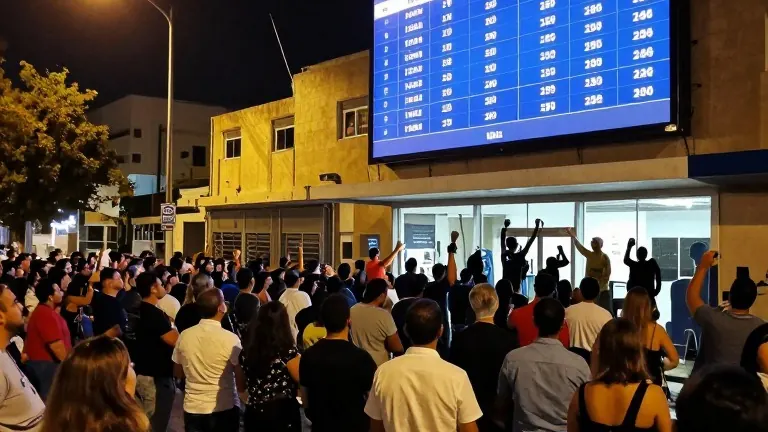
Exit polls from Israel's general election showed Prime Minister Benjamin Netanyahu's right-wing bloc and former military chief Gadi Eisenkot's opposition grouping deadlocked at 51 seats each in the 120-seat Knesset early on Wednesday, with neither side able to command a majority alone.
Two Israeli broadcasters projected that Eisenkot's Yashar party and three other Jewish opposition parties in his Change Bloc would win 51 seats, matching the total for Netanyahu's Likud party and its far-right and ultra-Orthodox allies. A third broadcaster's poll gave Netanyahu a lead of three seats. Later updates from Kan and Channel 13 held the blocs level at 51 seats apiece, while Channel 12 put Netanyahu's bloc at 52 seats and Eisenkot's at 49.
Voter turnout reached 77.7% when polls closed at 22:00 local time, the highest level at that hour since 1999, according to the Central Elections Committee. The committee rejected a request from Likud and several other right-wing parties to extend voting hours, saying the current circumstances did not justify an extension.
Neither bloc can govern without support from smaller parties. The two Arab parties, the United Arab List and the Joint List, were projected to win 18 or 19 seats combined, a record for Arab parties in a Knesset election. Turnout among Arab Israelis, who make up about a fifth of the population, was reported to be strong.
United Arab List leader Mansour Abbas said he hoped the final numbers would allow the Change Bloc and the United Arab List to reach 61 Knesset seats together. Joint List chairman Yousef Jabareen said his grouping cannot be ignored under any political scenario. Only one party has openly said it would work with Arab parties in government.
Official results are due to begin publication overnight, but about 600,000 absentee ballots, mostly cast by military personnel and representing around 10% of the total vote, will not be fully counted until Thursday. Once counting is complete, Israel's president will consult all political factions and invite the party leader judged most likely to build a governing coalition. That process could take weeks, and failure to form a government would trigger another election.
Eisenkot told supporters at his Yashat party headquarters in Tel Aviv that they had made history, and he pledged to ensure the people's decision is translated into a stable Zionist government. His ally, former prime minister Yair Lapid, called the result a crushing defeat for Netanyahu's bloc. Netanyahu later appeared at Likud headquarters in Jerusalem and said his right-wing bloc had a great majority.
Foreign Minister Gideon Saar, an ally of Netanyahu, said celebrations on the left were premature. National Security Minister Itamar Ben-Gvir urged supporters of his Jewish Power party to pray for a full-on right-wing government. At Likud headquarters, supporters told the BBC they were nervous about the outcome.
This was the first Israeli election since the Hamas-led attacks of 7 October 2023 and the wars that followed in Gaza, Lebanon and Iran. Campaign issues included accountability for the security failures that preceded the 7 October attacks, the conduct of regional wars, the distribution of military service obligations, judicial reforms and Israel's international standing.