Oxford Street traffic-free zone opens to mixed reactions ahead of Christmas
Nearly half the famous London shopping street has been closed to vehicles, with shoppers praising the extra space while some drivers and cyclists cite new obstacles.
By Jessica Abebe ·
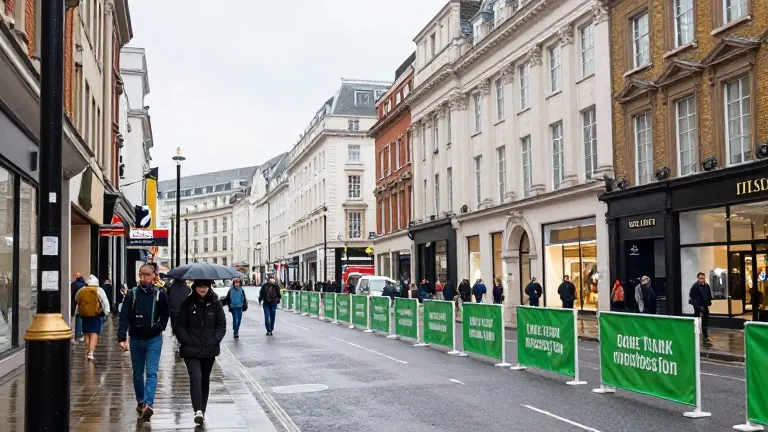
London’s most famous shopping corridor has entered a new phase of urban planning, closing a major section to all vehicle traffic in time for the holiday season.
The closure spans roughly half of the 1.2-mile stretch of Oxford Street, running from Oxford Circus station to Marble Arch. Buses, taxis, private cars, bicycles, e-scooters, and pedicabs are now banned from the pedestrianized zone.
Mayor Sadiq Khan described the opening as a momentous day, noting that the street had been in decline over the previous two decades. He stated that pedestrianizing the area, combined with improved public transport links and added greenery, aims to improve the overall experience for visitors and residents.
Shoppers present on the Monday morning opening expressed enthusiasm for the changes. Daniel Te, who moved to London from the United States in July, said the extra space made the street more inviting than in the past. Te, a former city planner, noted that he previously avoided the area because it was too crowded, but he is now more inclined to visit. He described the pedestrianization as a significant achievement and suggested that neighboring streets should also become car-free.
Raquel Cox, a visitor from Ireland, traveled to the street after seeing news coverage of the project. She said the change offered a better shopping experience, though she acknowledged that surrounding streets might face increased congestion. Abbas Shigival, who runs a souvenir kiosk at the start of the pedestrianized section, observed that the morning was slightly busier than usual. He called the environment more pleasant and noted that people appeared happier with the freedom to walk.
Transport for London chief operating officer Claire Mann said the diversion of double-decker buses to neighboring roads would not affect reliability. She indicated that there remained plenty of capacity for passengers and that the Elizabeth Line and Bond Street provided alternative routes. The permanent transformation of the street, a £150 million project involving trees, seating, and event plazas, is scheduled to begin in spring 2027.
Not all road users welcomed the change. Ben McMullan, a taxi driver, reported that traffic on surrounding streets had worsened and that accessibility had become a challenge. He cited a mother with a pram and a woman with walking difficulties who struggled to reach their destinations without direct car access. McMullan feared the lack of curb-side access would deter some customers from using taxis.
Cyclists also faced obstacles. Jack, a construction worker who preferred to keep his name private, said security guards stopped him and other cyclists from using the street. He argued that the new route made his commute longer and disagreed with the principle of pedestrianization, comparing it to the low-traffic neighborhoods that already exist in the city.
The current phase is considered a proof of concept by the Mayor, who stated that London would closely monitor the changes to ensure they work for everyone. The goal is to demonstrate that investing in people rather than traffic leads to better footfall and spending.