Debate Erupts Over Emergency Care After Spanish Soccer Player Dies
Investigators are reviewing the medical response given to Jesús de Miguel after a collision, with questions raised about the timing of CPR and the use of a defibrillator.
By Nadia Singh ·
Questions about the emergency medical response are centering on the death of Tenerife forward Jesús de Miguel, who died Tuesday after a collision during a match. The 30-year-old player suffered a cardiac arrest on Monday after a mid-air clash with Andorra goalkeeper Jesús Owono. While the police have opened a standard investigation into involuntary manslaughter, medical professionals are now scrutinizing the specific care de Miguel received on the pitch and in the ambulance.
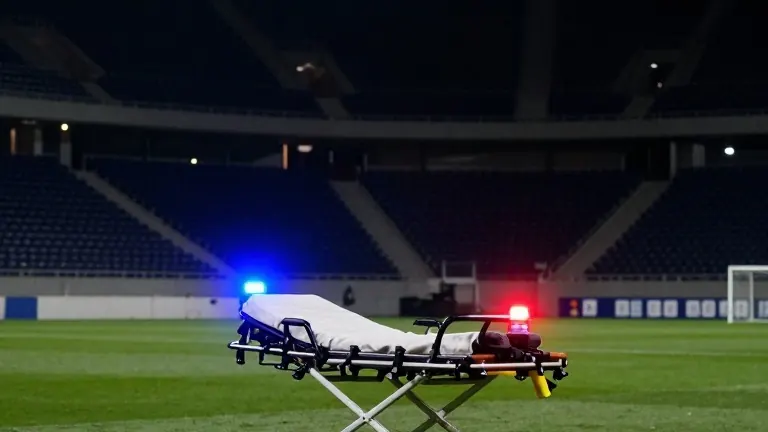
De Miguel collapsed late in the game after being struck by Owono. Team medical staff reached his side 20 seconds after he fell. Emergency workers arrived within a minute, carrying a stretcher to the field. He remained prone on the pitch for five minutes before being moved to an ambulance waiting just outside the playing area.
Conflicting reports have emerged regarding the exact sequence of medical interventions. Some Spanish media outlets stated that de Miguel received cardiopulmonary resuscitation in the ambulance and regained a pulse. Other reports claim the CPR was performed on the field. It remains unconfirmed whether a defibrillator was used during these initial minutes.
Elvira González, president of Spain's Association of Nurses, Emergency Medics and Caregivers, said her group is requesting more details. She stated, "We can't say if they acted correctly or incorrectly, but we can demand that all the emergency procedures follow international standards of correct practice." González emphasized that CPR must begin immediately and that a defibrillator is essential in the first minutes to restore a pulse before moving the patient.
Rayco García, the largest shareholder of Tenerife, acknowledged the need for clarity. Speaking to Cadena Ser on Tuesday, García said, "There are those who say that the impact caused his death, and that later they were able to stabilize him artificially even though it was very difficult to bring him back." He added that the club's medical team followed protocol and responded quickly. García noted that the ambulance did not enter the field because the club's medical service did not order it to approach.
Spanish soccer federation regulations require the home team to have at least one doctor on site and an ambulance equipped with life support, including a defibrillator, ready at all times. La Liga did not respond to requests for comment on these protocols. The National Police in Madrid and Tenerife declined to comment on whether the medical treatment is part of their probe.
De Miguel is survived by his wife and one-year-old daughter, who were present at the game. His parents traveled from the mainland to Tenerife, part of the Canary Islands archipelago. The team plans to travel to Toledo for a funeral tentatively scheduled for Thursday. Fans have left flowers outside the stadium, and Owono issued a statement expressing his pain and respect for the coming process.