Control Center Cleared High-Speed Train While Other Was Stopped, Recordings Show
Audio logs indicate the Atocha dispatch center instructed the AVE to proceed at normal speed despite the Iryo train being unable to restart.
By Nadia Singh ·
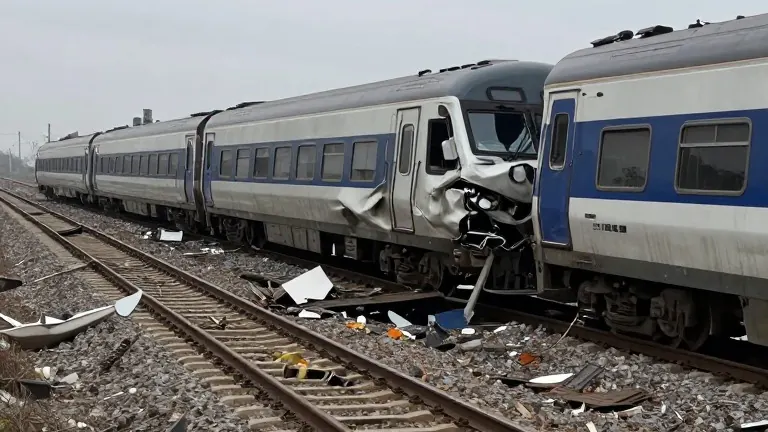
Audio recordings released on October 29, 2026, reveal that a train control center in Madrid authorized a high-speed AVE to move at full speed while another train sat stationary on the same track. The collision occurred near Urda, in Toledo province, shortly before 9:00 a.m. local time. The impact killed at least 69 people and left dozens injured.
The incident involved two passenger trains traveling the Madrid to Sevilla route. Both were equipped with the LZB signaling system, a technology that monitors speed and position in real time and can apply brakes automatically if safety limits are exceeded. A widespread computer glitch stopped both trains about 140 kilometers south of Madrid. The Iryo train, which was traveling ahead of the AVE, remained halted for approximately 30 kilometers before the crash.
The recordings capture conversations between operators at the Atocha control center and the two drivers. The audio shows the dispatchers discussing how to manage the situation after the LZB system failed. They attempted to determine the best method for the trains to pass the affected zone. The operators then issued specific instructions to the drivers of both trains.
At 8:41 a.m., an operator spoke to the driver of the Iryo train, identified as number 6076. The driver reported that the train could not restart due to a transmission fault. Despite this report, the operator instructed the driver to disconnect and reconnect the LZB system and resume travel under the BSL backup system at normal speed. The driver acknowledged the order with the words, "Vale, perfecto, pues muchas gracias."
The Atocha center gave similar instructions to the driver of the AVE train, number 2080. The operator told the driver to disconnect and reconnect the LZB system and resume movement at normal speed under BSL protocols. The driver asked for confirmation regarding the speed limit. The operator responded, "Sí," confirming that normal speed was authorized.
The BSL system, or lateral signaling blocking, controls safe separation between trains using physical signals located beside the tracks. It serves as a fallback when the primary LZB system is offline. Under standard protocols, if the LZB system fails, trains are required to move at a safety speed capped at 40 kilometers per hour. This slower pace allows drivers to see obstacles and stop in time if necessary. The recordings indicate that the AVE was cleared for speeds up to 200 kilometers per hour.
In a later communication at 8:48 a.m., the Iryo driver informed the control center that the train still had not moved. The operator replied that the train should proceed as soon as possible. The AVE was approximately 30 kilometers behind the Iryo at that moment. Five minutes after this exchange, the AVE struck the rear of the stationary Iryo train.
Transportation Minister Oscar Puente described the sequence of events as inexplicable. He stated that the decision to resume circulation without the safety system fully restored rested with the control center. Puente noted that the operators chose to restart movement under circumstances that remain unclear to authorities. The investigation into the crash began immediately following the accident.
Spanish authorities are reviewing the audio logs to understand why the Atocha center issued these specific orders. The standard procedure for an LZB failure requires a reduced speed limit to ensure driver visibility and reaction time. The recordings suggest that this protocol was not followed for the AVE train. The investigation aims to determine the exact sequence of decisions made by the dispatchers in the minutes leading up to the collision.