Kazakhstan Releases Second Tiger As Villagers Brace For Return Of Apex Predators
The $30 million reintroduction project now has two big cats in the wild, but local farmers worry their cattle are at risk.
By Julia Novak ·
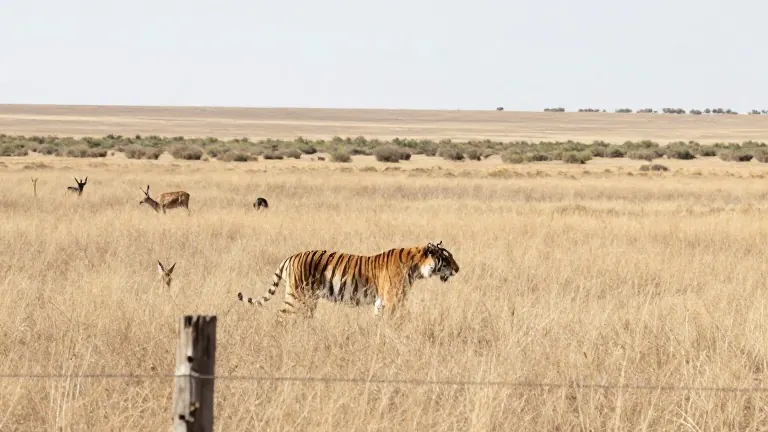
Two tigers are now roaming the Kazakh steppe, ending an absence of nearly 80 years. On November 2, the country's Ecology and Natural Resources Ministry confirmed the release of a male tiger named Amur into a dedicated nature reserve. He joins a female tiger named Umit, who was introduced to the same habitat on July 31.
The pair inhabit the Ile-Balkhash State Nature Reserve, located roughly 300 kilometers northwest of Almaty. Umit has already demonstrated her ability to survive in the wild. Within ten days of her arrival, she hunted and consumed a boar and a wolf. Officials describe her adaptation to the environment as successful, setting a precedent for the newly arrived Amur.
Local sentiment remains divided as the predators settle in. Valery Bilyachenko, who operates a fishing base near the release site, notes that residents are largely opposed to the initiative. His village relies on livestock farming, and pastures sit just tens of kilometers from the tiger habitat. "The main livelihood in the local villages is livestock farming," Bilyachenko said. "There are pastures and cattle, and naturally, local people are worried that the tigers will kill their animals."
To manage these concerns, the ministry has deployed satellite tracking collars on both tigers. Their movements are monitored continuously. When a tiger approaches a settlement, automated text messages alert nearby residents. The government has also promised to maintain specialized "anti-conflict" teams. These groups will be dispatched to scare the animals away if they begin encroaching on human territory or livestock grazing areas.
Alibek Kuantyrov of the Ecology and Natural Resources Ministry stated that the primary objective is to create a stable, self-sustaining population. While the current pair is unlikely to mate, the project aims to restore a species that once thrived in the region. Kazakhstan was home to a large tiger population until hunting and habitat loss reduced the number to an estimated 10 animals in the mid-1930s. By 1948, the big cats had vanished entirely from the modern territory.
The reserve was established in 2018 and prepared for this specific purpose. More than 200 deer and over 100 kulans, a native donkey-like animal, were introduced to serve as a food source for the tigers. The $30 million effort is a joint venture between Kazakhstan and Russia, with funding from the World Wildlife Fund, the UNDP, and the Kazakh state.
Sergey Aramilev, director-general of Russia's Amur Tiger Center, called the project a global signal. "No country has ever restored a historically extinct species of large mammal, especially a predator," he said. Two additional young tigers are scheduled for release in 2027. The long-term goal is to have around 50 tigers roaming the wilderness, which could transform the area into a hub for tiger-spotting tourism.
For now, the focus remains on the survival of the first two animals. Bilyachenko predicts little impact on his business in the near term, though he acknowledges that the growing population may change how people use the outdoors in the region. The reserve stands ready for the next arrivals, with the prey base already in place to support the expanding cat population.