A 55-ton spaceship anchors 'Dune: Part Three's' opening sequence
Production designer Patrice Vermette details the logistical challenges of burying a massive set piece for the final film in the franchise, set for release on December 18.
By Julia Novak ·
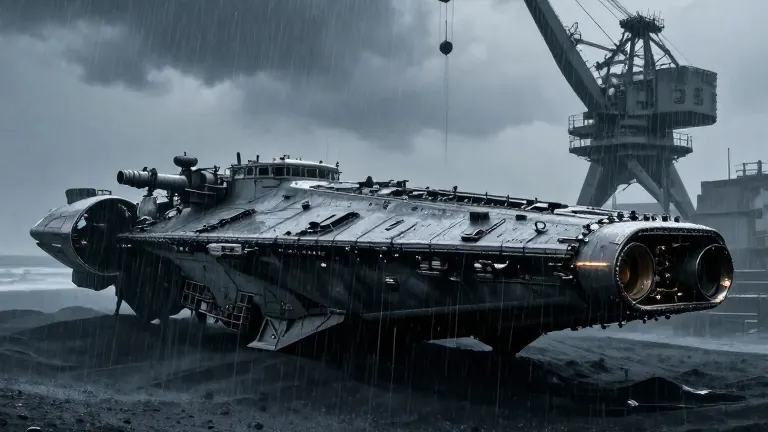
Moviegoers will encounter a 55-ton spaceship in the opening sequence of 'Dune: Part Three.' The vessel is a central element of a battle scene set against a backdrop of black sand. The film opens in theaters on December 18.
The third installment concludes the story of Paul Atreides, a character portrayed by Timothee Chalamet. The narrative picks up 17 years after the events of the previous film. It is inspired by Frank Herbert's novel 'Dune Messiah.' The plot explores the consequences of Paul's rule as emperor.
Patrice Vermette served as the production designer for the project. He received Variety's Creative Impact Award this year at the SCAD Savannah Film Festival. During a recent conversation, he described the film as a major spectacle. He compared the experience to watching fireworks, where the final effect is the most impressive.
Director Denis Villeneuve gave Vermette one primary instruction: do not repeat sets from previous films. Vermette followed that directive throughout the design process. He stated that the team wanted to challenge themselves to make each visual distinct, even within the same fictional world.
The opening sequence presented significant logistical hurdles. Vermette had to build a single ship that allowed for a 360-degree view of both its interior and exterior. The crew buried the structure underground for filming. Rain was a constant element of the scene, requiring the use of spider rigs and touch spinners.
Water management was a critical part of the production. A pump system removed water from the set continuously. A crane lifted the ship every two days during the daylight hours. Vermette noted that the effort was worth it to achieve the desired visual impact.
Vermette and Villeneuve first collaborated on the 2013 film 'Enemy.' Their partnership began after Villeneuve sent a text message when Vermette was dropped from 'Dallas Buyer's Club.' Vermette described that message as life-changing. They had known each other since the early 2000s but had not previously worked together on a feature film.
Villeneuve had been planning a 'Dune' adaptation since he was 15 years old. He provided Vermette with the first 100 pages of the script. Vermette studied the material and revisited the source novel to understand the filmmaker's vision. He emphasized that objects in the fantasy world must remain grounded in reality to tell a story effectively.
The production required the creation of several new locations. These included the planet Giedi Prime, which drew inspiration from industrial septic tanks. The team also built the Atreides Castle and the Imperial Nexus Laboratory on Arrakis. Working with cinematographer Greig Fraser, the crew executed scenes without relying on artificial lighting tricks.
Vermette described the process as a collaboration between department heads. They worked together to solve logistical problems. He cited the Imperial Nexus Laboratory as an example where the team refused to give up on complex ideas. The final result allows for a visual experience that avoids repeating the sets established in the earlier films.