Maricopa County completes routine vote count despite online conspiracy noise
The third-largest U.S. voting jurisdiction processed over 256,000 in-person ballots without major disruptions, prompting local officials to praise operational transparency.
By Jessica Abebe ·
Maricopa County concluded its November 3 election with minimal operational friction, processing votes for a jurisdiction containing more than 2.5 million registered voters. All 254 voter centers opened on schedule, and the county reported that more than 200 locations maintained wait times of 10 minutes or less throughout the day. The election took place against a backdrop of national trends favoring Democratic candidates, yet local results proceeded without the major public disputes that have characterized previous cycles.
Adrian Borunda, a communications officer for the county elections department, described the process as functional and uneventful. He noted that the absence of scandal was the primary indicator of success for a well-run election. The county had prepared for various potential disruptions, including bomb threats, weather events, and federal interference. Officials also addressed administrative errors during early voting, such as the election vendor mailing ballots too early and the Recorder’s Office failing to relabel 25 eligible voters after a non-citizen investigation.
Responsibility for the tabulation process shifted from the Recorder’s Office to the county elections department on the Friday before Election Day. This transition required a late-night push to prepare machinery and staff. Borunda characterized the shift as smooth despite the late hour. On Election Day, more than 256,700 voters cast ballots in person. While one polling station in Laveen experienced a power outage before opening, no other major technical failures were reported. Department of Justice monitors were present in Maryvale, but ICE agents did not arrive as suggested by some federal officials.
Local political leaders offered mixed assessments of the event’s execution. Republican Supervisor Thomas Galvin stated that the county managed a complex logistical operation effectively. He emphasized that the election was heavily scrutinized but remained transparent. Democrat Secretary of State Adrian Fontes graded the state’s election performance between an A and an A- during a press conference. He acknowledged that no election is perfect but affirmed that the process met high standards. Borunda agreed with Fontes’ assessment, calling it an A-level standard.
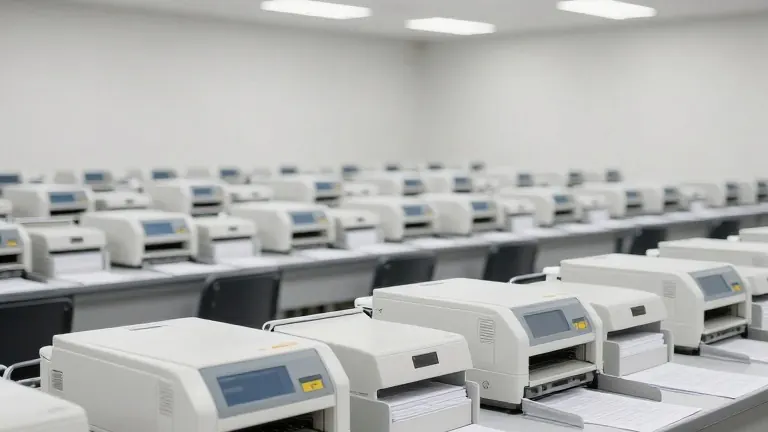
The county expects to finalize its vote count by 5 p.m. on Sunday at the earliest. Voters have until that deadline to cure any ballot errors under state law. The average finalization period for the county is 13 days, though the 2024 cycle took 10 days. Borunda expressed hope that the majority of the count would be complete by the end of the week. Election employees continued verifying signatures on thousands of ballots at the Maricopa County Tabulation and Election Center after top-line races were called.
Online criticism persisted following the election, primarily from figures who had previously promoted election denial narratives. Kari Lake, a former Arizona politician, focused on the power outage in Laveen as evidence of a stolen election. She called for an audit despite the 2020 audit finding no fraud. State Senator Mark Finchem claimed the results showed major interference without citing specific evidence. Borunda noted that the conspiracy theories were limited in scope compared to past years and were often echoed by individuals outside the state.
Several Republican candidates who lost their races conceded without invoking fraud. Alexander Kolodin, the Republican candidate for Secretary of State, acknowledged a stunning rebuke to the national Republican party. Warren Petersen, the Republican Attorney General candidate, stated that the party would accept the results when counting is done. Elijah Norton, the Republican candidate for state treasurer, argued that crying over spilled milk leads to continued losses. Galvin used a Board of Supervisors meeting to criticize colleagues who supported conspiracy theories, stating that the behavior damaged the party locally and nationally.
Galvin urged Republicans to move past what he called the CyberNinjas era. He claimed that those pushing fraud theories were lying and that their actions cost the party during the blue wave. He suggested that these individuals needed to look in the mirror for the party’s current state. By Thursday afternoon, the media tent outside the tabulation center was empty. No protesters were present. An employee in a gray T-shirt continued preparing ballots for tabulation, a routine task in a 4,000-person operation.